
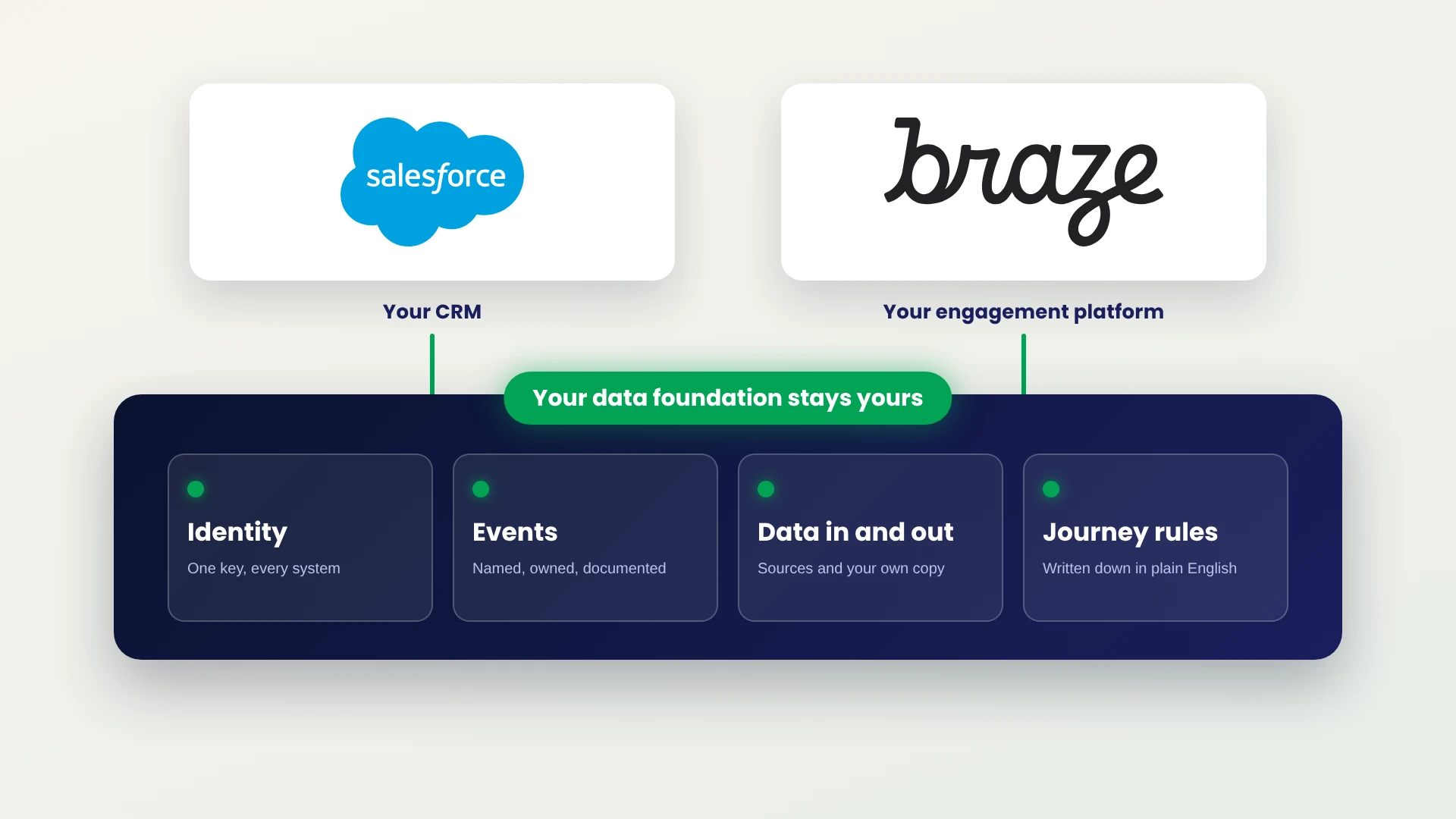
Salesforce is acquiring Braze under a definitive agreement announced on 20 Oct 2026, with closing expected in Salesforce's fiscal year 2028. Until then, the two companies stay separate and your contract continues as is. CustomerIK's view as a Braze implementation partner: the teams that do well will own their identity, event data and decision logic, whatever the roadmap becomes.
Key Takeaways
- The agreement was announced on 20 Oct 2026, and closing is expected in Salesforce's fiscal year 2028, subject to conditions including Braze shareholder approval and regulatory approvals.
- Braze has told customers that their existing contract continues as is and that their account team stays the same until close.
- The release sets out no pricing, packaging or integration dates, so this post does not guess at them.
- Identity, data sources, engagement history, naming and journey rules are decisions that stay with your team on any platform.
- A five-step portability test shows whether someone new could rebuild your programme from documents alone.
- Foundation work is safe to do now. Builds against a combined product that has not been announced rest on a guess.
What has Salesforce announced about Braze?
Salesforce announced a definitive agreement to acquire Braze for approximately $5.66 billion in enterprise value. Holders of Braze Class A common stock will receive $47.50 in cash per share. The release says the deal is expected to close in Salesforce's fiscal year 2028, subject to customary closing conditions, including approval by Braze's shareholders and required regulatory approvals.
The release is careful about what is still a possibility. It says Braze's real-time engagement and AI decisioning capabilities are expected to complement all four layers of Salesforce's architecture, named as Data 360, Customer 360, Agentforce and SIForce. It sets out no pricing, packaging or integration dates, and this post does not guess at them.
What stays the same until the deal closes?
Braze has told customers that their existing contract continues as is and that their account team stays the same. Braze and Salesforce remain separate, independent companies until close. The email gives the expected close as Salesforce's fiscal year 2028, which begins on 1 Feb 2027.
Braze's chief executive says the company will continue building as Braze. The same email says some of the future integration ideas are possibilities and that no decisions have been made yet. Questions without answers will be answered by Braze directly, so your account team is the right first stop.
What does Salesforce acquiring Braze mean for your data foundation?
Braze's architecture guide puts it plainly: at a high level, Braze is about data. Everything a marketer does in the dashboard, from segments to journeys to personalisation, runs on the identities, events and attributes your team put in. Platform news changes the roadmap around that data, not what it says about your customers.
Both companies describe a shared commitment to an open, composable approach that gives customers flexibility across the data, tools and partners they rely on. We read that as good news for teams with a clear foundation.
Flexibility is only useful if you know what you own, so this is where CustomerIK puts its attention. In our experience, a clean identity and event model shortens any later integration or migration more than any single feature does. Our customer data management service covers identity resolution, CDP integration and data governance.
Which parts of your Braze set-up are yours to own?
Braze documents the mechanics and leaves the decisions to your team. The table below sets the documented mechanics against the decisions that stay with you. Each right-hand cell is our reading, not Braze documentation.
| Layer | What Braze documents | What stays your decision |
|---|---|---|
| Identity | Braze says user IDs, called external_id values, should be unchanging and accessible when a user opens the app. | Which identifier is your master key across systems, and who creates it. |
| Data in | Cloud Data Ingestion can sync data from Snowflake, Amazon Redshift, Databricks and Google BigQuery. | Which tables are the source of truth, and who owns their schema. |
| Data out | Currents is a real-time stream of engagement events to a data warehouse or analytics partner. | Whether you hold your own copy of engagement history, and in which system. |
| Data model | Braze says your custom data will impact how your user base is classified and segmented. | How events and attributes are named, defined and documented. |
| Zero-copy access | Connected Sources let Braze directly query your data warehouse to construct segments without copying the data. | Which data you are comfortable leaving in place, and who approves new queries. |
Notice how much of the right-hand column is decisions rather than configuration. Those decisions are portable between any two platforms. That is the argument for treating them as assets worth writing down.
How do you test whether your foundation is portable?
This is CustomerIK's test, not Braze guidance. Run it with the people who own your data and your journeys. A programme that passes all five steps can be rebuilt, audited or moved by someone who was not in the room when it was built.
- Write down your identity key, where it is created, and every system that holds it.
- For each attribute you use in segments, name the one system that writes it and the one person who owns it.
- List every custom event with its name, its trigger and its owner, and retire duplicates.
- Record the entry rule, exit rule and frequency rule of each live journey in plain English, outside the dashboard.
- Check that you can rebuild a recent month of engagement history from data you hold, whether through Currents or your warehouse.
The pass mark is simple. A new colleague should be able to describe any journey from the documents alone. If they cannot, you have found the work worth doing before any roadmap announcement.
What should you avoid changing while the deal is pending?
Our recommendation is to avoid reactive moves. The deal has not closed, your contract continues, and Braze says nothing changes in how it serves you. There are two failure modes we would plan against.
The first is freezing the roadmap while waiting for clarity. Foundation work such as identity clean-up and event documentation pays off under every outcome. Waiting for news delays the part of the plan that is safe to do now.
The second is building connectors to a combined product that does not exist yet. The release talks in terms of what is expected and what would be possible, so any build against it today rests on a guess.
Which questions belong with your Braze account team?
Braze says questions without answers yet will be answered directly as they arise. Take a short list into that conversation.
- Ask for your renewal date and how the existing contract applies after close.
- Ask which integrations you rely on today, so the team can tell you where any change would touch them.
- Ask where product and partner updates will be published during the pending period.
This post does not settle any contract or legal question. Treat the list as a way to get documented answers from the source rather than relying on commentary, including ours.
What does this mean if you run Braze and Salesforce together?
If you run Braze and Salesforce together, the data foundation matters even more, because two systems must agree on who a customer is. CustomerIK's Braze implementation, integration and migration work includes migrations from Salesforce and other tools. Our case study on a migration from Salesforce Marketing Cloud to Braze covers how journeys and data points were audited and mapped.
Our accelerators reflect both sides. Abridge is a Braze Amplifier built to automate Salesforce-to-Braze transitions, and Conduit connects a hospitality property management system to Braze. CustomerIK's offerings include listed Braze Amplifiers and Salesforce AppExchange offerings.
For customers on either platform, our commitment stays the same: a clear path, a solid foundation and outcomes that hold up as the ecosystem comes together. As a Braze Solutions Partner, we will update this post as Braze and Salesforce publish more.
How does this connect to the rest of the programme?
The foundation work above links to topics we have covered in more depth. Our guide to integrating CRM data into Braze covers the identity and field-mapping decisions behind step one. The article on tracking user events helps with step three.
If you plan to adopt Braze AI features, data readiness for BrazeAI Decisioning Studio shows what those models need from your data. For the wider plan, read how to build a customer engagement strategy with Braze and connect Braze with external analytics platforms. Our view on which Braze AI features to adopt first sets out the sequencing.
Frequently Asked Questions
1. Has Salesforce's acquisition of Braze closed?
No. The agreement was announced on 20 Oct 2026. Closing is expected in Salesforce's fiscal year 2028, subject to customary conditions including Braze shareholder approval and required regulatory approvals.
2. Will Braze keep its name?
Braze's chief executive says the company will continue building as Braze and investing in its community of customers and partners. Salesforce has not published naming or packaging details beyond what is in the release.
3. Do I need to change my Braze contract now?
Braze has told customers that their existing contract continues as is. This post does not settle contract or legal questions, so take renewal and change questions to your Braze account team.
4. Should I pause my Braze roadmap until the deal closes?
Our recommendation is not to pause the work that is safe under any outcome, such as identity clean-up and documenting events and journeys. Hold off only on builds that depend on a combined product that has not been announced.
5. Why does Cloud Data Ingestion matter for this?
Braze says Cloud Data Ingestion lets you connect your data storage solution directly to sync user data to Braze. In our view, it keeps your warehouse as a source of truth that sits outside any single platform.
Sources
- Braze, Salesforce Signs Definitive Agreement to Acquire Braze. Retrieved 21 Oct 2026.
- Salesforce, Salesforce Signs Definitive Agreement to Acquire Braze. Retrieved 21 Oct 2026.
- Braze, Braze Cloud Data Ingestion. Retrieved 21 Oct 2026.
- Braze, Braze Currents. Retrieved 21 Oct 2026.
- Braze, Getting started: Architectural overview. Retrieved 21 Oct 2026.
- Braze, email from the Braze chief executive to Braze customers, received 20 Oct 2026. This is a customer email, not a public page.
- Deal terms and timing are forward-looking statements by Salesforce and Braze and may change before close. Check the Braze investor relations page for updates.
- Written by CustomerIK, a Braze implementation partner.
CustomerIK is a Braze implementation partner working across onboarding, technical integration, marketing operations and customer data management.
If you would like a second pair of eyes on your identity model and event list before the deal closes, let's talk.